Mid and Long-term vision was presented on Jolla PhoneDay1.
You should find it in the video stream - not sure whether the slides are available elsewhere…
2 Likes
Regarding points 3 and 4 it is important to realise that Jolla cannot do much (anything?) about it.
Google has locked down Android by moving functionality into Play Services. They obviously do this to maintain an iron grip on the ecosystem.
Some developers at some banks/institutions/companies are requiring the full Google checks for their app to function.
Note that some Banking apps do function with SF and AAS. So it’s not an issue with SF.
What needs to happen is that those developers who lock everything down with Google Play Services need to hear from their customers that they are blocking their legitimate users/customers.
I think this is one of the most important parts of being a community driven system: it requires our active participation. So please contact your bank and let them know they are blocking your access to your accounts on the device of your choice.
Same with the government apps. If they talk about digital sovereignty, they should be open to supporting a European mobile OS.
Now, you shouldn’t expect this to change everything overnight, but that change can only come if we keep telling them they need to embrace this.
18 Likes
There should be a SailfishOS “work group” that would approach banks et al and discuss with the right persons about getting their apps working on SFOS.
The likelihood of an individual customer making an impact is not very high. I once contacted a bank and the experience was somewhat kafkaesque. Before Aurora store I approached my bank asking whether it would be possible to have their app downloadable on their website. I explained that I was using SFOS and therefore couldn’t use Play store. I might find their app somewhere by googeling but I didn’t find that secure enough. So I got an answer from a random marketing clerk saying that their bank was an avantgard in IT solutions and that I could download the app from Play store.
9 Likes
You’re saying Jolla Phone is not ready for daily use because a specific mail provider and a specific instant message app don’t work?
10 Likes
Yes, that’s a very good solution indeed. Doesn’t Jolla have an Ecosystem Director or something like that? It would definitely pay off to create this:
- Fast and secure way to publish an existing Android app to a Jolla controlled store
- Documentation of security policies and best practises for publishing a sensitive Android app for use on SF
- Engaging with public bodies to make sure every citizen can use their identification/services app on SF
- Engaging in partnerships for EU-subsidised R&D projects that eg Jolla Phones with Euro Office and Nextcloud native integrations to a large number of civil servants who are migrating under the digital sovereignty movement
- Working with like minded phone makers (Fairphone eg) to broaden the hardware offering
- Creating a touch point for Jolla users to suggest apps for active support in porting to SF
- Create a number of national campaigns with national partners to make sure (as an example) that all Finnish banks and public services are available and working on SF. Then go for each country in the EU following a certain priority list based on user numbers.
I’m sure more ideas can be suggested. But SF definitely needs this to create a viable ecosystem that can grow in users and available services.
What Jolla also needs to improve, quite frankly, is their marketing. The communication around the launch was practically non-existent. The livestream is still on YT but you have to scroll through over an hour of people coming in before you get to the talks. No bookmarks to help. Why not publish the keynotes as separate videos??? Publish some shorts with key moments that enthusiastic users can share. Etc etc.
But that doesn’t mean that users cannot also contribute by contacting banks etc
7 Likes
Yes!
In my dreams there is also the possibility to have on-device payment capabilities coming with Digital Euro. It would make a lot of sense to offer it on a fully European OS.
3 Likes
Well, some institutions require strong integrity, but that’s an exemption. I have only experienced that with local credit union.
I’m currently on GrapheneOS device and could say that basic integrity (which is not so hard to get) is enough in the most of cases. Just there sometimes might be registration issues (account opening) with some neobanks.
I’ve also was able to open Revolut account with only basic integrity
Theoretically to get basic integrity on Jolla Phone, Magisk and Play Integrity Fix would be enough (but I’m not sure if that’s actually possible on Jolla’s container). It just has to pretend that it’s a real Android device, but doesn’t require keys and/or TEE
1 Like
Well said @Damien_Jolla and @rhampf 
Count me in. Atleast for Finland. Should I create a new thread for this?
6 Likes
Unfortunately, Jolla weather and Meecast stopped working last week. Uninstalling, deleting all the files and directories remaining after the uninstalling process (why do I have to do that, anyway?) and reinstalling the apps after that didn’t help. The Jolla weather app just shows a white screen and Meecast (last version from openrepos.net, .21… shows spinning wheel on the desktop and disappears after some seconds.
Did anybody encounter the same problems or even have a solution?
I didn’t find anything helpful in the discussion forums of the apps 
1 Like
You’re very right, it’s possible to trick uncertified/tampered/etc. devices to pass at least basic levels of Play Integrity API, but there are some considerations here:
- Bypassing Play Integrity API is a lot of work for all parties involved. For developers, they are always playing a cat and mouse game, and they really must be active. For users, they always need to make sure that their modules are up to date and relevant.
In my experience, I used Google Pay for some time, and I had to always make sure my (rooted) device was passing Play Integrity, otherwise Google Pay would not work. And there were numerous times I was glad to have a credit card with me, because Google Pay decided to just not work. And if we were not to take Google Pay in mind, I had to always tinker with Play Integrity and modules, if I wanted some apps like McDonald’s for instance to work.
- Not a lot of people talk about it, but, in my experience, you not only need Google Mobile Services installed, which is not the case out of the box with AAS, but you also need a Google account registered and logged in to that particular device/AAS instance. Because Play Integrity API cannot actually evaluate your device if there’s no Google account.
So, if you decide to install GMS and log in to a Google account, even if you have AAS, doesn’t that defeat (at least partially) the purpose of having a Linux smartphone that gives you privacy and freedom?
I am not here to tell anyone how they should or even must use their device. It’s up to all of you to make decisions. But I just want to give some clarity here.
Also, it’s not an easy decision to switch banks, but it’s the clearest path, in my honest opinion. There are banks which don’t fiddle with their applications, because maybe they don’t care about how their application works, because maybe if it works, it works, why need to change it, but also because of elderly people that will flood them with complaints, if the application changes in some way. Furthermore, because people with lower income also have and use banking, some banks are more lenient towards older, “unsecure” smartphones. In my testing with the Jolla Phone (2026) and AAS with microG, I have found that at least 3 popular banks in my country have applications that don’t test Play Integrity API, root, etc. Which definitely opens some leeway here. I am not saying that such a thing will last forever, but it’s definitely more of a long-term solution, than fiddling with Play Integrity and Google, in my opinion.
4 Likes
At least in the desktop computer world GNU/Linux is now regarded more than before when you could only get SW for Win or Mac. I hope the same will one day become reality for mobile phones, though that might depend a lot on “how much sellable data can my app scrape from the user’s phone” as it has been observed with Whatsapp (“WhatsUp” and “Mitakuulu” flagged as malicious third-party apps by Meta), XMPP (protocol shut down to make way for proprietary solutions for Meta and Alphabet) and other messengers. In my country more than 30 banking apps are developed and maintained by the same company which depends on iOS and Google Play for the auth process, and that locked me out of normal phone banking behaviour time and again (I use workarounds now, but it would be nicer if we got native, official and signed SFOS apps for that). The problem for everyone is that SFOS can be deemed “rooted by design”, which is a big scary no-no for money-making/money-processing companies, so I don’t see an official solution arrive too soon.
Cheers
2 Likes
This can change if Jolla supports those banks and institutions with a technically solid solution, proper documentation for the developers and support if needed.
Banks and instutions probably don’t need to change much in their apps and authentication processes, evidenced by the fact that many do work. It is probably a matter of switching a couple of settings.
However, they will only do that if there is a credible framework for it AND if they see that a group of their customers need it to use their services.
So Jolla should do the first and we the users do the second…
3 Likes
I did create a separate thread for Finnish payment/banking apps work group. Name can be edited if somebody comes up with more clever name.
8 Likes
Sounds like this bug:
2 Likes
Yes
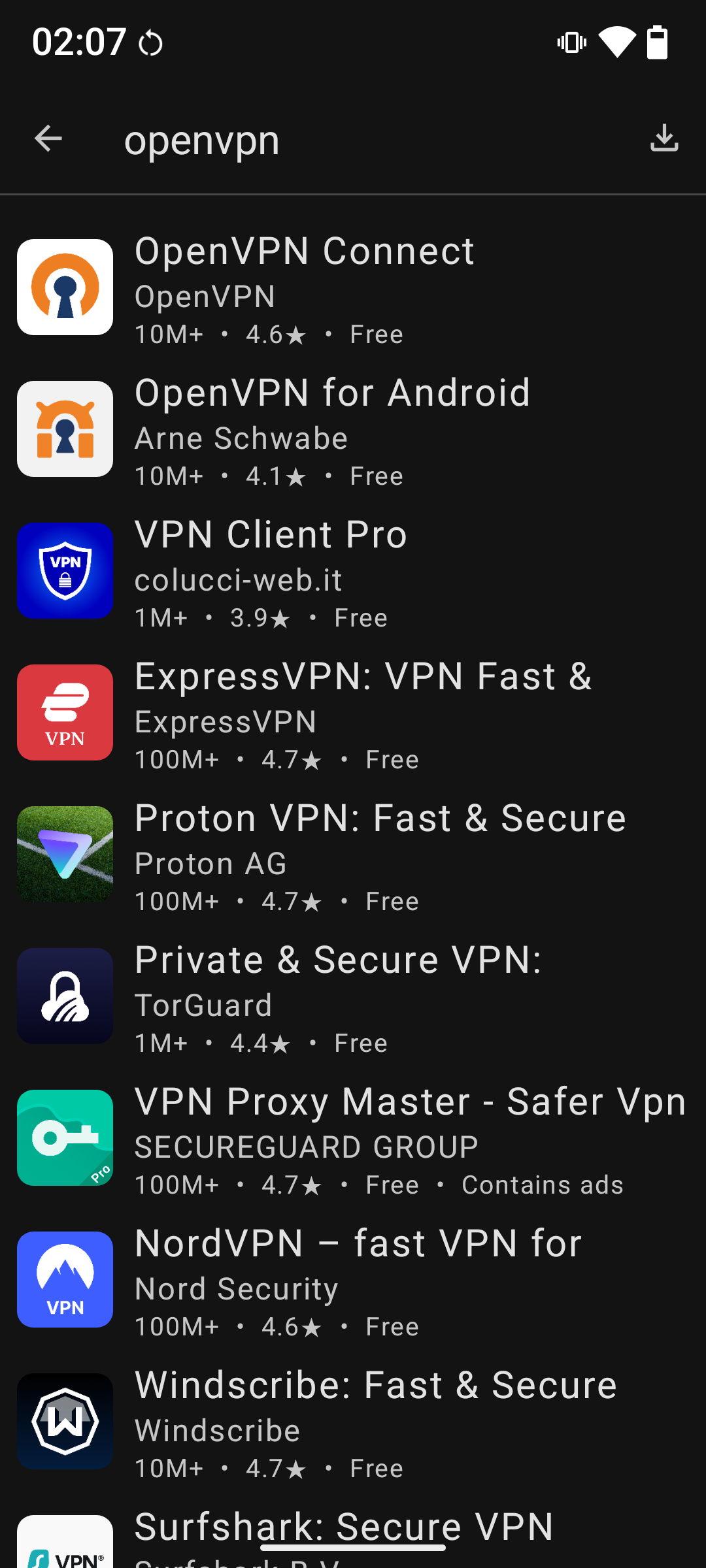
It’s available on Aurora, OpenVPN Connect, I use it on my Pixel with LOS and my laptop with my VPN provider OpenVPN Connect - VPN For Your Operating System | OpenVPN
1 Like
Android VPN apps won’t work on Sailfish OS. In simple terms, AppSupport gets its internet connection from Sailfish itself. So you have to use the OpenVPN (other VPNs are also available) in Sailfish’s settings (and yes, it is NOT an app).
5 Likes
What the other meant about VPN not being app is that apps just do it easy for user to configure the VPN. In SFOS as apps on android side won’t do much do to being on container, you need to configure VPN on SFOS side. And as there are different kind of ways to configure VPN connection it is made so that you need to set the parameters in the setting manually. One time job if I have gotten it right
4 Likes
Settings > VPN > Add VPN > OpenVPN.
Now that was easy, wasn’t it?
3 Likes
There are OTP apps that conform to widely available standards. If banks wouldn’t always reinvent the wheels in very poor ways, everybody would be able to do online banking on an SFOS device.
But that’s a bit off-topic and has nothing to do with the usability of the J2.
1 Like
Everyone who searches for Threema in this forum can read that I posted several times about this. Threema is a Swiss, well encrypted chat service. European, other than Whatsapp and Telegram not part of Big Tech. They also developed Threema Libre, a Foss app. You pay once for the app. Threema Libre can be paid at Threema itself (not via the Play Store). You get a license key that you can use for the FDroid app. My family uses it. Before we tried Wire, but that did not work well.
10 Likes