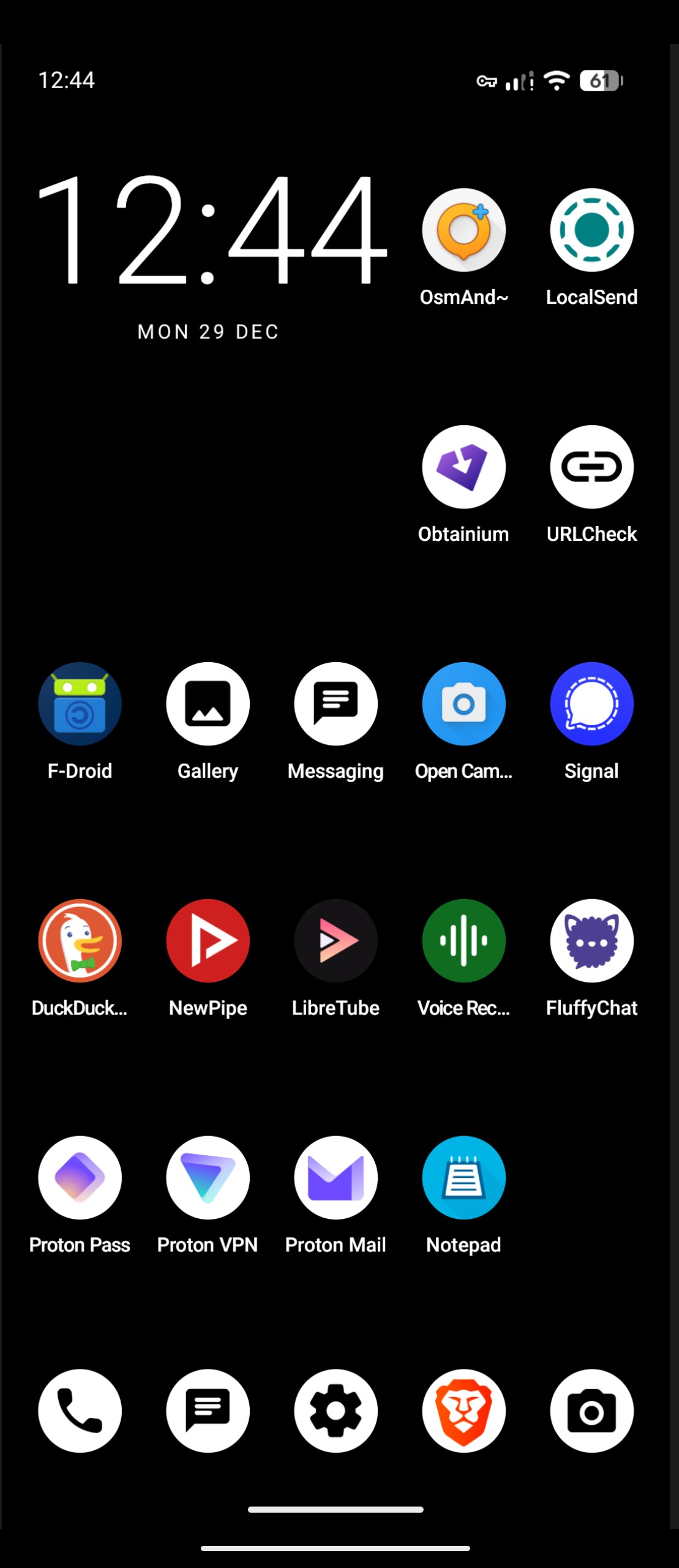
Since the topic has shifted to Android in a broader sense, this is all I want from a phone: notepad, Signal, maps, emails, ad blocking browser, camera, clock, and password manager.
SFOS has clocks, calendars, note taking apps, password managers, and a native camera app. I can use Proton Mail in a browser. Proton VPN has a command line program. System wide ad blocking using the hosts file (locked on GrapheneOS). I installed YouTube players for long journeys but never use them.
I’ve read about running browsers in containers, which I’d like to learn more about. Signal is available from the Guardian Project repo on F-Droid with full functionality – hopefully. I think it might even be deGoogled. The only remaining question is a map and navigation app. OmAmd~ for Android should be fine assuming it can utilise the Jolla phone GPS. Brave Browser for Android might also be preferable. I would prefer to use native apps but it looks like Signal for Android is the most secure choice for now.
My frustration is wanting to get more involved with a developing product while having no real frame of reference. All I know is Android and desktop Linux.
There’s a few maps applications for Sailfish, of which I prefer Pure Maps the most. Together with OSM Scout Server, another application, you can use offline maps as well.
Do note that most officially supported Sailfish devices until now have had less-than-stellar GPS performance. It can take ages to get a GPS fix, although once you’re connected to a satellite, it’s smooth sailing from there.
For emails, if you don’t need to send encrypted mails, Jolla’s mail application works quite alright.
As for Proton VPN, I don’t know if it uses an obscure connection method, but you should be able to set up pretty much any VPN service from the settings application.
For Signal there is a native app named Whisperfish by @rubdos. I’m no Signal user, so I can’t say to much about it.
For maps I use a combination of the already mentioned Pure Maps (together with OSM Scout Server) by @rinigus and OSM Scout by @karry. For hiking I prefer OSM Scout, for car navigation Pure Maps.
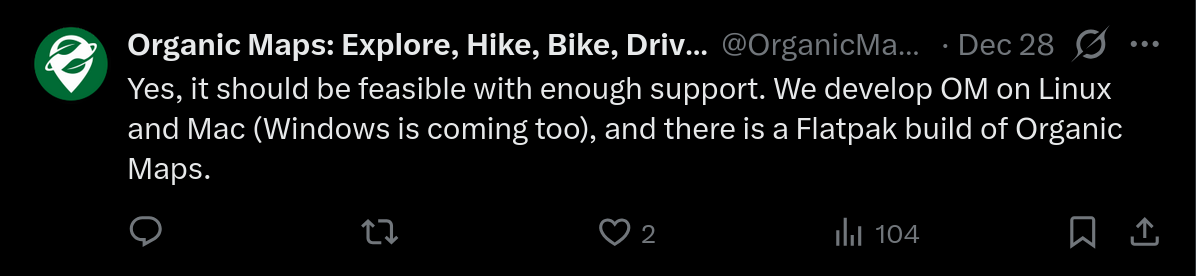
I’m worse than useless at that sort of thing. The question remains: if my future Jolla phone has an Android compatibility layer, is it even worthwhile porting? Android Organic Maps is an offline capable program, so security is less of concern. I’m trying to parse how feasible the compatibility layer really is. In my mind free software is free software. Organic Maps and OsmAnd~ for Android work really well (on Android). I understand the desire to create native software or adapt existing software but a primary marketing claim from Jolla is full Android app support. If I buy one of their phones will it fully replace my Android device? There is no way to know until it arrives. I exclusively use free software with no Google Play Service requirement.
I wish there was an equivalent to ProtonDB for checking app compatibility.
I see your point and my expectations are all over the place.
Sailfish is a slick and mobile friendly Linux distro that doesn’t natively support any of the GUI Linux or Android apps I use every day.
I’d like to support Jolla and my current phone will need replacing anyway. Hypothetically I would prefer a SailfishOS tablet and to stay with my small selection of Android apps from first party developers (Proton and Signal) via F-Droid on an Android phone.
At the end of the day I believe in local manufacturing and independent software. Piggybacking off Google’s Android isn’t ideal. They made a worse version of Linux to keep people like us out.