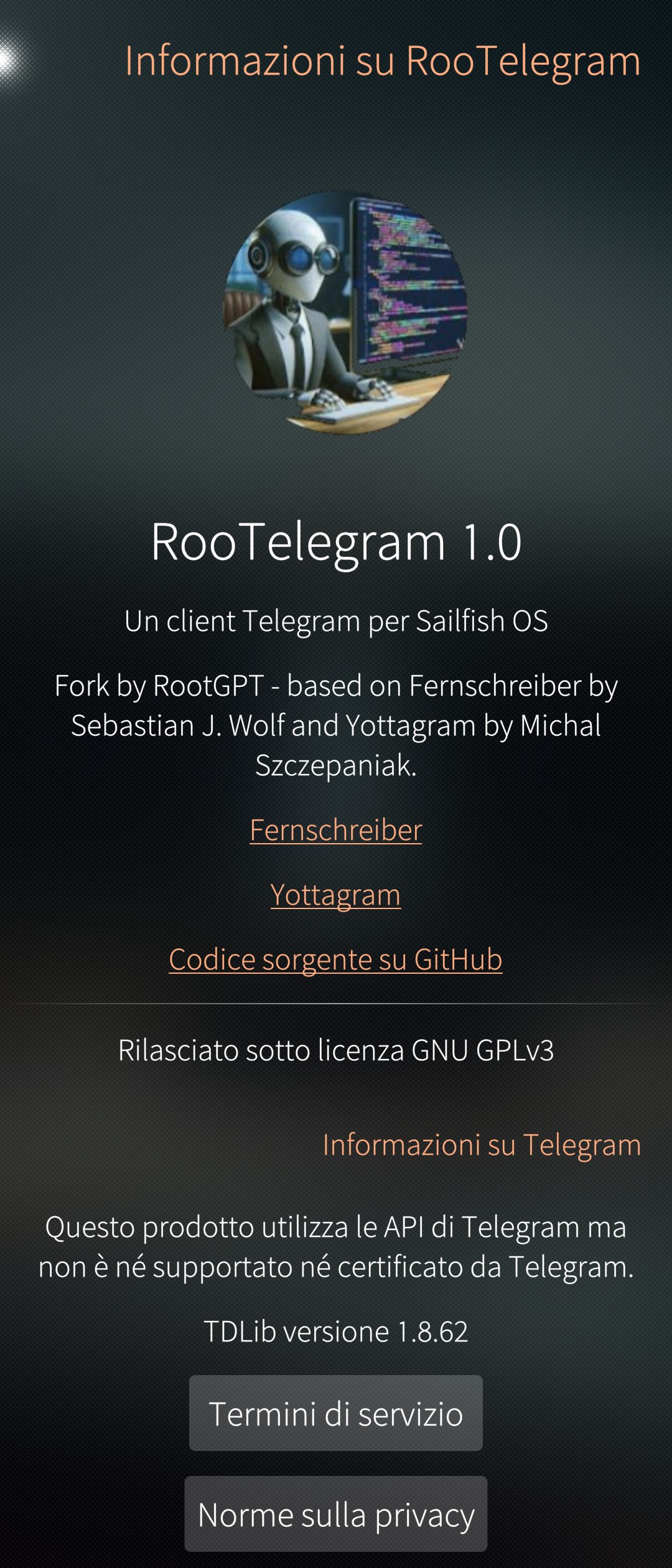
[ITALIANO] RooTelegram è un nuovo client Telegram in sviluppo per SailfishOS, pensato per offrire un’esperienza leggera, veloce e perfettamente integrata con l’interfaccia Silica. Anche se il progetto è ancora work in progress, l’obiettivo è chiaro: diventare il client Telegram più fluido e completo disponibile sulla piattaforma. L’app punta a un’apertura immediata, notifiche affidabili e un design moderno in QML, mantenendo coerenza con l’estetica e la filosofia di SailfishOS.
Funzionalità già implementate
Modifica dei messaggi — inclusa la formattazione (grassetto, corsivo, monospazio…).
Notifiche funzionanti — con gestione stabile degli eventi.
Demone notifiche — per ricevere messaggi anche a schermo spento.
Gestione cartelle — creazione, modifica e tutte le opzioni correlate.
Emoji premium — supporto completo.
PIN dei messaggi — possibilità di pinnare messaggi nelle chat.
Selezione testo avanzata — selezione parziale e copia del testo.
Gestione richieste di accesso ai gruppi — per admin.
Menu Condividi nativo — integrazione con il sistema SailfishOS.
Miglioramenti formattazione — immagini, monospazio e anteprime link più pulite.
Scheda utente completa — Media, Audio, Documenti, Link e Gruppi.
Funzionalità ancora da implementare
Gestione gruppi e canali — creazione e opzioni avanzate.
Stati — visualizzazione e invio.
Traduzione messaggi — possibile integrazione AI.
Chiamate vocali.
Videochiamate.
Presto pubblicherò anche il codice aperto sulla mia pagina GitHub.
[ENGLISH] RooTelegram is a new Telegram client under development for SailfishOS, designed to offer a lightweight, fast and fully integrated experience with the Silica interface. Although the project is still a work in progress, the goal is clear: to become the smoothest and most complete Telegram client available on the platform. The app focuses on instant opening, reliable notifications and a modern QML-based design, while staying consistent with the aesthetics and philosophy of SailfishOS.
Implemented features
Message editing — including formatting (bold, italic, monospace…).
Working notifications — with stable event handling.
Notification daemon — receive messages even when the screen is off.
Folder management — creation, editing and all related options.
Premium emojis — full support.
Pinned messages — pin messages in chats.
Advanced text selection — partial selection and copy.
Group join request handling — for admins.
Native Share menu — integrated with SailfishOS.
Improved formatting — cleaner images, monospace text and link previews.
Complete user info tabs — Media, Audio, Documents, Links and Groups.
Features still in development
Group and channel management — creation and advanced options.
Statuses — viewing and sending.
Message translation — possible AI integration.
Voice calls.
Video calls.
I will soon publish the open-source code on my GitHub page as well.
The list of features too. @RootGPT What’s your reason for forking instead of contributing to Fernschreiber or Yottagram? Both @WerkWolf and @Mister_Magister are nice people and I’m sure they’d review your contributions.
Regarding Fernschreiber, I actually started from that project (I also spoke with Sebastian Wolf recently). Since it had been abandoned for quite some time, I decided to take it over, update it, and modernize it so it could become something current and actively maintained.
With Yottagram, the situation is different: @Mister_Magister and I simply have two different visions of what a Telegram client on SailfishOS should be.
My goal with RooTelegram is to achieve full feature parity with the official app, while keeping the interface essential and extremely responsive.
Yottagram is definitely a great project, but it follows a different direction, one that doesn’t really match what I want to build.
So my choice wasn’t against anyone — it was simply about vision and development goals.
If it was so easy everyone would have done it. In fact you’re one guy, telegram has a team of people, and trust me, telegram can pump out features faster than you can implement them.
No in fact if you want full featureset you should contribute instead, because with 2 people it’s easier to keep up
Might be stupid question, but I’m wondering, if original project owner isn’t anymore participating actively on the project, wouldn’t it be better if they moved the project ownership to other person who want to actively develop it?
If you implement a real daemon so the frontend part does not need to be open all the time I am your man. Fernschreiber never wanted to implement that and Yottagram does not really have a daemon, but just throws the whole app in the background. It can only be stopped by killing it, starting it will always bring it to the foreground again. That’s why I still use Depecher, which has a nicely implemented daemon part and can be stopped/start in the background via a systemd service during the night for example. But Depecher is getting very old and does not support newer features.
I understand your point. I never assumed that reaching full feature coverage would be simple or quick.
For me, this project is mainly a personal challenge — a way to learn, improve, and experiment with something complex.
I’m not trying to bother anyone or create unrealistic expectations. I’m just working on something I enjoy and sharing the progress in case it might be useful or interesting to others.
RooTelegram sits right in the middle: it isn’t a standalone systemd daemon with its own service unit, but it’s far more than a simple foreground app. Thanks to its DBus‑activatable daemon mode, the process stays alive in the background, reuses the running instance, and can open specific chats directly from notifications. The UI can be closed without terminating the backend, and because the process remains warm, opening the app and loading messages is essentially instantaneous.
It looks very good. Some useful upgrades from Fernschreiber as well - message formatting, telegram chat folders, etc. There are some places for me, being English, (e.g context menus) where the text looks like some of it it in Italian, rather than English, also in folders (‘Tutte’ instead of ‘All’).
One thing I don’t like about Fernschreiber is in one-to-one chats the messages are all in a straight line, so its difficult to see at a glance who said what. Yottagram does this better by aligning messages from one person on one side of the screen and messages from the other on the opposite side of the screen. It would be great to have this in RooTelegram as well.
Thx for feedback. This is a work in progress, there’s much work to do, like translations. However, have you have tryed a long press on “Tutte” (All)? There’s a good menù for create folder, delete folder or move folder up or down. And a command for “mark all message as read”.
I meant that he would have transfered the project to you, compared to forking it. With old name and all, could have been just updated in Harbour etc. But anyway, always great that devs are doing what they have passion!
Thank you, but I don’t really agree. My fork follows my own vision, and I believe it’s right for it to remain a fork of the original project. At least, that’s how I see it.
In my opinion, everything written by AI should be marked as AI. Projects that were created by people should be untouchable. If you want to create a new telegram client using AI, don’t touch what was created by humans. Appreciate their hard work.
Maybe just a few comments from my side here. Well, it’s obvious that I haven’t had much time to work on Fernschreiber in the last few years, but I’m still around and I’m pretty responsive on Telegram if you reach out to me. The statement by @RootGPT that they reached out to me is only correct in a way that I received an e-mail and a Telegram message on the SFOS Fan Club group today about this fork - so in parallel to the official release. The statements here give a bit the impression that I abandoned Fernschreiber completely and the fork was done because of that. Well, as far as I’m aware of I wasn’t contacted before…
Moreover, the statement that “there’s very little of Fern left at this point” in this client bends the truth maybe a bit. If the code that was published on GitHub really reflects the client in its current state, I’d say that most of this new one is still Fernschreiber code. And hey, it even uses my namespace. But well, that’s how it is…
This behavior combined with the fact that all the other contributors have been stripped from the README of the new client makes me a bit hesitating to even try it out. It doesn’t give a very trustworthy feeling. To me, first impressions matter and this wasn’t the best one tbh, but let’s see what comes next.
Ok, considering how much I’ve been attacked for this app, it’s clear that RooTelegram isn’t as appreciated as I had hoped. I’m also sorry that some things, like the namespace, remained in the code, but as I had already pointed out, I would have changed it as soon as possible. Anyway, I’m cancelling the release of RooTelegram.
Honestly, I assure you that my intentions were good and I didn’t want to hurt anyone, but apparently that’s not how it turned out.