I would like to report that today I did not receive an emergency alert when one was broadcast. The subscription settings are set to default. There are numerous forum threads on this, so the problem likely isn’t new.
4 Likes
This is very IMPORTANT, especially nowaday (in France, there are fires, floods, heat waves that can trigger emergency messages from autorities…I think other countires have also some other reasons), so this should be an ABSOLUTE PRIORITY to Jolla Team to work on and test that it works reliably in every counrty and with every phone operator (at least in countries where the Jolla Phone is offically delivrable).
I’ll be happy to test for France.
5 Likes
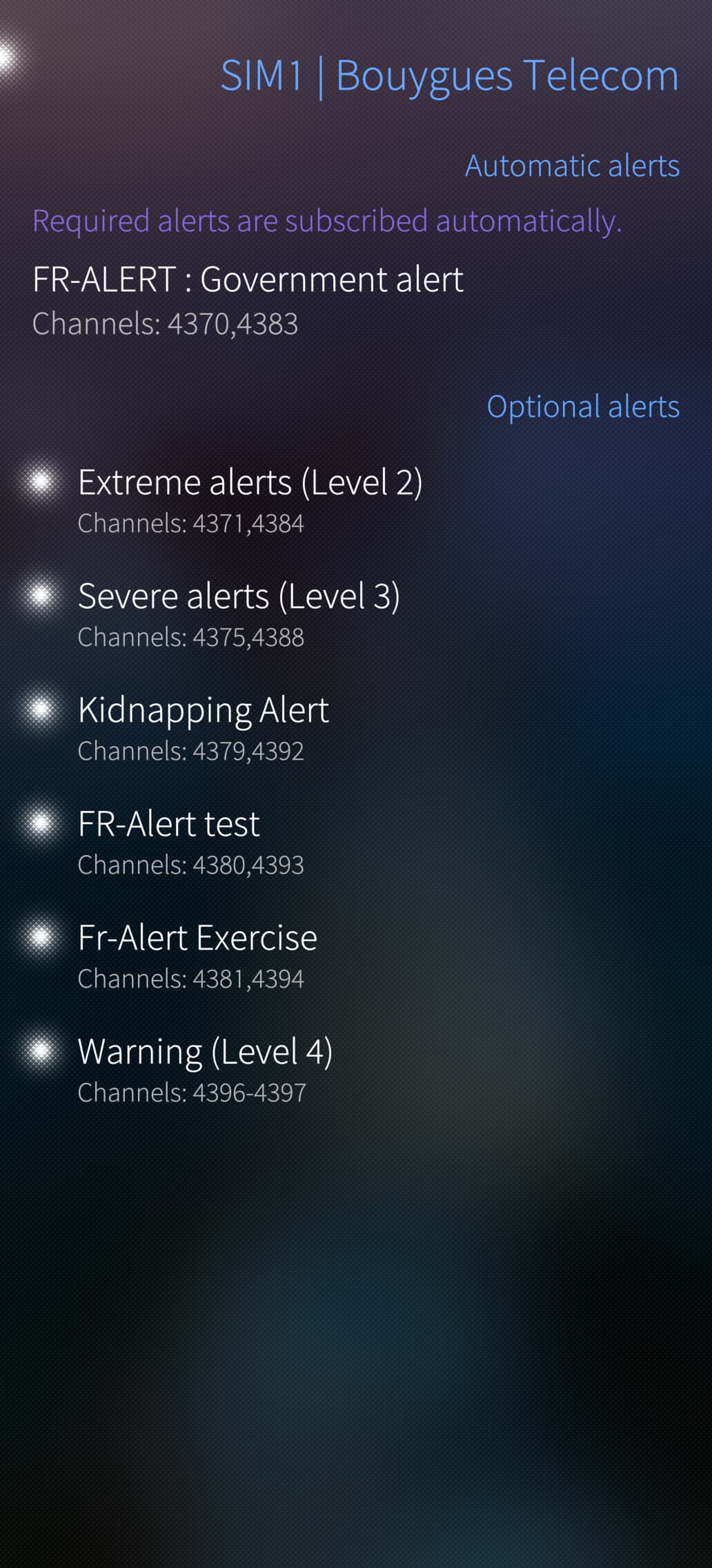
Subscriptions forn my operator seems to be automatically retreived and activated by default (I did manually activate TEST too), but I did not get any, so I cannot say if it works reliably.
1 Like
I received two alerts in France last year. My x10III didn’t have that feature, but I still received them via text message.
I think there’s a duplicate text message sent for each alert, depending on the network transmission cycles.
If you didn’t receive a text message, there may not have been an alert in the area where you were.
There’s a test alert at least once a year in Aveyron; I’ll test this feature then.
2 Likes
I was just answering to Andreyv message. I do not think I missed any alert on my side, but as far as I know there were none in my area since I switched to my Jolla Phone 2026 since july.
Btw @andreyv you should share more info on your phone, its state…as much info as possible so Jolla team can check (here or by direct message with Keto if sensible information).
I think you should also mention the country this is affecting currently. You should be able to PM @Keto with this information + what country you are from, if you don’t feel like sharing here publicly.
3 Likes
There are improvements coming for the emergency alerts handling, for example support for extended cell broadcast messages
22 Likes
Thanks a lot, @Keto, for confirming that this is being taken care of.
It is important for us, as end users, to know that you are listening, taking our feedback into account, and working on the reported bugs/issues and suggested improvements… despite the vacation season and limited CAPEX/resources.
We know that communication also takes time, especially with limited resources, but it is crucial for many end users and community members. Even a brief acknowledgment makes a real difference.
Thanks again to you and the Jolla team for your work and commitment. Your efforts are appreciated — and you have my full support from France! 

7 Likes
Critical Analysis of Cell Broadcast: Privacy and Control
Cell Broadcast (CBS) is a one-way notification technology that transmits messages to all devices within a defined geographic area, without the recipient’s explicit consent. Here are the documented critical aspects:
1. No opt-out at the highest level
For Level 1 (national alert), the ETSI TS 102 900 standard stipulates that opting out is not permitted. The device cannot disable reception of these messages. The user never chose to receive them and cannot refuse.
2. Override of user settings
CB messages bypass silent mode, “Do Not Disturb,” and zero volume. The device imposes itself on the user’s will: no individual control.
3. One-way nature and lack of consent
The system does not require opt-in. Unlike SMS or apps, the citizen has never consented to receive these messages. It is a forced “push,” not a communication one has joined.
4. Geo-targeting without explicit consent
The message is delivered based on the network cell location. The user has not authorized the use of their location for message delivery.
5. Risk of political and non-emergency abuse
In 2025, the Philippines’ Office of Civil Defense condemned the misuse of the system for electoral campaigns, with messages mimicking emergency alerts. The CDMA document warns that some agencies have used the system for non-critical information (“where to vote,” municipal events), causing public desensitization.
6. Spoofing vulnerability
Academic research (2019, ACM) demonstrated that a single malicious base station (eNodeB) with 1 Watt of power can transmit fake CB messages to 49,300 devices in a 50,000-seat stadium, with a 90% success rate. The system lacks an intrinsic strong authentication mechanism on the device side.
7. Absence of individual acknowledgment
The system does not know who received the message (it is “passive” and “non-tracking,” as noted by CELLCAST). This is a privacy advantage, but it also means there is no accountability: the message issuer cannot verify actual receipt, and the user has no feedback channel.
8. Grey zone: emergency vs. control
The same infrastructure that saves lives during an earthquake can carry any textual message to millions of people simultaneously. The distinction between “emergency alert” and “mass government communication” depends entirely on the governance and good faith of whoever controls the entry point (Cell Broadcast Entity). There is no intrinsic technical control that prevents non-emergency use.
In summary: Cell Broadcast is not in itself a population control tool, but it is a unilateral, non-revocable, non-consensual, and potentially abusable technology whose safety depends entirely on the institutions that manage it. In regimes with weak or authoritarian governance, the tool loses its protective nature.
2 Likes
Did you just copy paste an ai summary? But why?
7 Likes
Yes, i search information about the tech information about because I didn’t fully understand how it works is only for understand what is this technology, because not everyone know what it is, i think that is a bad feature to have in the phone the fact that i have copy and paste from the ai is a problem for you? Are information like all other
I only ask to artificial intelligence to search information about control and privacy and this is the result doyou think that these information aren’t true?
AI summaries are sometimes quite hard to understand, which was probably the problem for Attah and I agree here. AI generates lot of text so it is sometimes hard to follow the red line.
But for the topic, I don’t agree. As Europe is currently the market for new Jolla phone I think we can trust that governments to not misuse the system for electoral campaigns etc. Those would backlash easily. Personally I’m super happy if Jolla can finally get all the emergency messages to come through! And that they work like emergency messages should, like bypass the do not disrupt. I believe these are one of the areas where phone users shouldn’t have the opt-in choice  I’m all for spoofing vulnerabilities tho! Don’t want to have random not emergency related messaging
4 Likes
Ok, that is your opinion, not mine, and I don’t agree with you on the fact that we can trust Europe. That said, I’m done and won’t be responding to anything else — I think it’s a waste of time.
LLM-generated, didn’t read, but picked up some keywords when scrolling past the wall of text. Oh no, big government is informing its citizens about a massive earthquake so I don’t die, what a massive invasion of my privacy.
Also, please consider the irony of sending your private thoughts to a chatbot hosted by a hostile company in a hostile state, to make it generate some word salad about how you care about privacy.
11 Likes
But from privacy POV, my understanding is that this is one way channel, nobody can collect any personal data from it?
1 Like
Guys, get a room hmm, topic.
5 Likes
Okay, where are you from? Then we can decide if we can trust you ;-).
1 Like
Please stop Ad Hominem.
“Send him to Zurich as punishment!”
A quote from The Kentucky Fried Movie.
1 Like