Distributing the original .rpm, as you do now, is fine under the license, but modifying it afterwards, even after the app is installed, still goes against the license terms.
I disagree, it is the same as using patch manager against proprietary parts of SailfishOS - it is your device and it’s yours to use. EULA is not enforceable in this case.
This RPM does exactly that but to an app.
As @pentti already suggested, it would be best if you renamed the app and used only what you created yourself.
See in my view I am using only the bits I created (the patcher and backend) and code you created (the UI).
I have a similar view of closed source, but nothing is black and white. Many amazing things would never have happened if they had to be open source.
I dare to agree to disagree
To me, the biggest problem with open source projects - thousands of forks that get abandoned after a few low-quality commits.
So creating a project that’s literally impossible to contribute solves that exactly how? You literally rely on one person to be maintain the software forever and to not do a rugpull on all users.
I don’t think publishing the source affects that at all, well maybe except reducing the number of new projects in fawor of pull requests (like for example I had recently, instead of making a massive maps app and reinventing the wheel I could just open 30 lines of code change to add one dbus api to pure maps).
Have you considered that a large part of the Jolla Phone is closed source? The 5G modem firmware, the Wi-Fi firmware. parts of Sailfish OS itself, and more…
Do I really have to? Ehh.
Okay so part of that comes from the OEM and neither Jolla nor us have any say to do that and unfortunately debugging/changing parts of these is not as easy as normal user space app…
And as far as I can tell there are plenty of efforts to reverse engineer firmware/drivers too - not my thing tho, look at mainline linux for mobile or linux on macbooks in general.
Justifying publishing closed source just because there already is closed source software is (imo) like saying throwing trash out the street is fine because there’s already trash on the streets. (just an example, if someone is doing something bad it doesn’t justify doing bad things in general).
Trust me, the more popular Sailfish OS and the Jolla Phone become, the more closed-source apps there will be.
And I would be super happy for that to happen! If there would be an official [literally anything] app that is properly configured with sailjail then I’m very happy to utilize that.
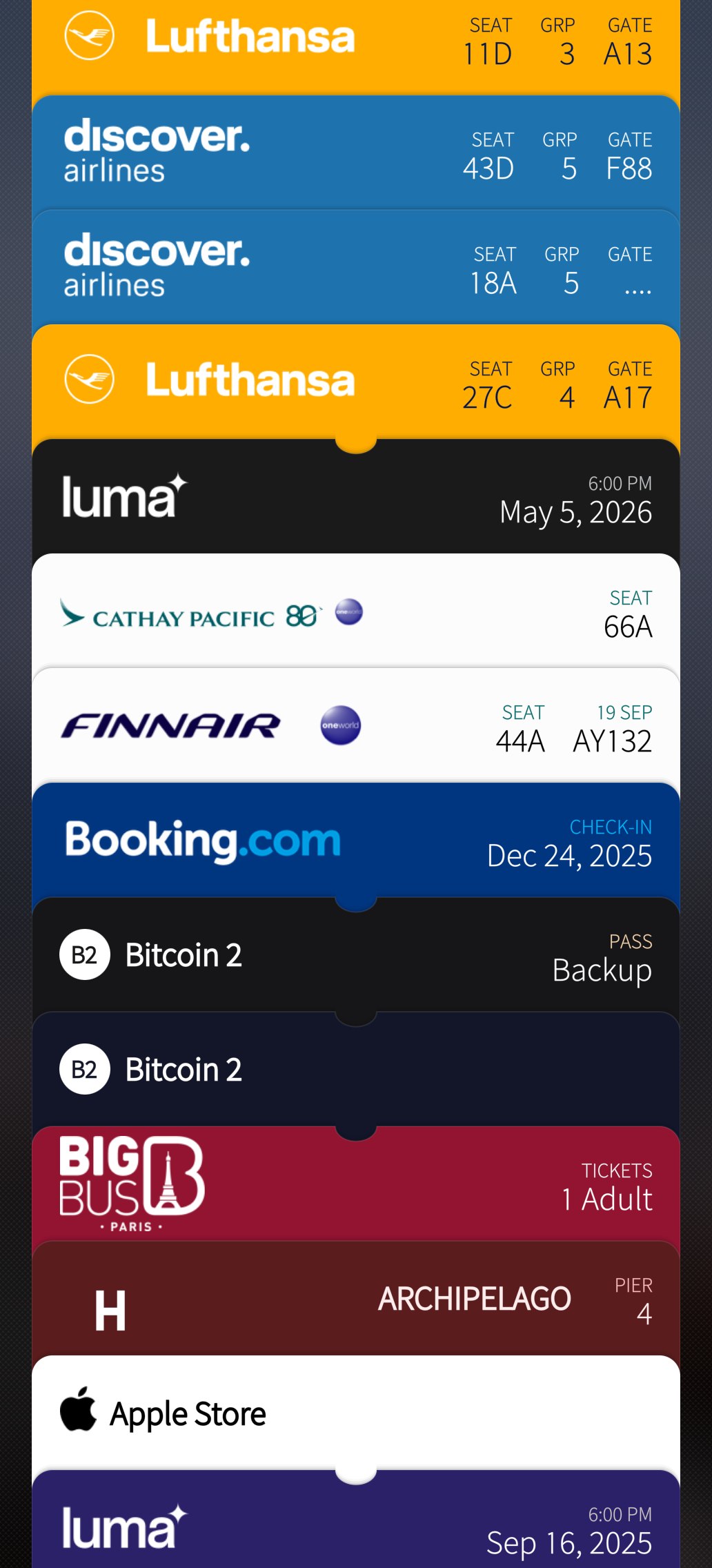
But if there is an app that holds very sensitive data and has default internet access and is not published by a trusted entity. By just sending one request extra (moving the pkpass to a central server) some malicious entity could currently generate damages for thousands of euro for me at more or less any point in time. In addition to getting all of my details (including PESEL, Passport number, history of like 5 years of all my travels and events I went to) someone could get actual cash moneys of mine (since using my travel example - most of returned flights I have keep the balance in the booking code which is part of the ticket - you see where I’m going with this. Someone who could extract all pkpass from my device can literally rob me.
That’s why all pkpass files I own are stored in a terrible flutter app I made (and now in this project), because I can’t think of single app app that hands of money and information if compromised in an easier way.
Of course to be clear - I don’t imply you are malicious, I believe you are honest but at the same time I see 1000 ways someone in the process of sailwallet could cause me severe personal/financial/identity damage - it’s just a risk I can’t take.
Also, the fact that I kept the app closed source doesn’t necessarily mean it has to stay that way forever. But right now, I’m very glad I did, and I’m convinced it was the right decision.
This whole thing would not be the case if I could simply open a PR, instead of resorting to binary patching…
Having the source code available is not automatically a guarantee of quality and security. It’s not only about what is in the code, but also about what isn’t there, or what might be missing.
the exact same sentence can be said in inverse.
That’s why reviewing source code requires deep knowledge of the wider context as well: how things actually work, and the other libraries the project depends on.
And how does closed source improve that?
I got a question in a private message about whether I used AI. Of course I used AI, like almost everyone else. I have never claimed otherwise, and I have never denied it. If you have the right tools and you know how to use them, they will hugely boost your productivity.
Again, without moral questions of what your AI was trained one wether someone can copyright AI code…
I’m not sure how that changes anything wether the source is open or closed - you still get the same risks and keeping source closed just means even less people/AIs looked at it and even less time was given to review the code.
And as I said a potential bad actor who can hack/exploit the binary code in sailwallet can cause severe financial loses.
The view that anything created with AI is automatically worthless is very wrong.
I do appreciate SailWallet and I do think I show that by using parts of it instead of prompting a model “yo do that”
With SailWallet, my goal was to create a high-quality app.
I do agree, as I said very good project.
I spent more than 14 days developing it, testing it and thinking deeply about it.
I’ve spent a few days on my backend too, and again I really appreciate your work.
what if the server returns a redirect instead of the .pkpass file? What if that redirect leads to an unencrypted HTTP website? What about cookies between redirects (for example, tracking cookies from URL shorteners)? They should not be stored or passed on.
I can think of very few cases where someone can control redirects of pkpass update but not the response itself… Considering that contents is literally two new lines away from headers in HTTP. Also pkpass needs to be signed so it’s not like update server can send malicious pass without full compromise. As for redirects: ApplePass (i think) could only give attacker the access to the pass (by fetching the update) which I think is fair to say they already have because they hacked the update server…
Anyway not the point. My point is how can I know? Do I sit with strace, gdb and mitmproxy watching over the app to see if it does what it says it does? How do I know if the app doesn’t have “if debugging” switches that change behavior? I do appreciate the effort you put into the app, and I don’t doubt it took some time. (and again, copying someone is the highest form of appreciation  - I could never make a good QML design without spending literal weeks on it).
This is my last post in this thread. Have a nice evening.
Have a nice day, I do hope for a reply tho.
———
@jaroslavm - how about accepting pull requests? You can still have a “all rights reserved” source available project that can get all benefits of being open source (most I guess) such as reproducible builds, PRs, or just use one of the open licenses that make it enforceable for everyone who builds upon your great foundation to contribute back!
I’m really serious I don’t think we need 4 wallet apps, 10 stores, 30 browsers and 700 youtube players. I would gladly submit PRs to existing software, especially that of good build quality - like yours.