I’m building some apps and looking for how large the interest truly is to get a TOH with light meter.
I love analogue photography and I’ve tried using the cameras and the photocell beside the front camera to measure light, both reflective and incidental, I get a lux metering from the photocell and no values at all from the cameras. However, the photocell must be without the right filtering cause it seems to reed IR light and well, I don’t get steady readings when calibrating.
So, I thought of building a TOH with a VEML7700 on the rear do have proper readings. I see two benefits: 1, the photocell is very good and will give accurate readings. 2 if placed on the right side of the rear cameras, the phone would be stable on a flat surface!
I’ve built two apps so far, both work well, I’m spending a week with each before posting on chum and submitting to Jolla store QA. It’s a proper Tuner and an advanced habit tracker, for those interested. Building a metronome and some other apps I’m missing as well
So, my question would you be interested? Cause either I build one and use myselft, or I get a bunch and share the love for film!
I WOULD honestly be interested in buying a TOH with lux meter that you can use with a light meter app?
I WOULD NOT be interested in buying a TOH with lux meter for a light meter app.
I voted no, because I don’t have a use for this kind of TOH at the moment. The idea is interesting nonetheless, and this doesn’t sound too complicated project to be doable alone, or too expensive product to do even in smaller batches.
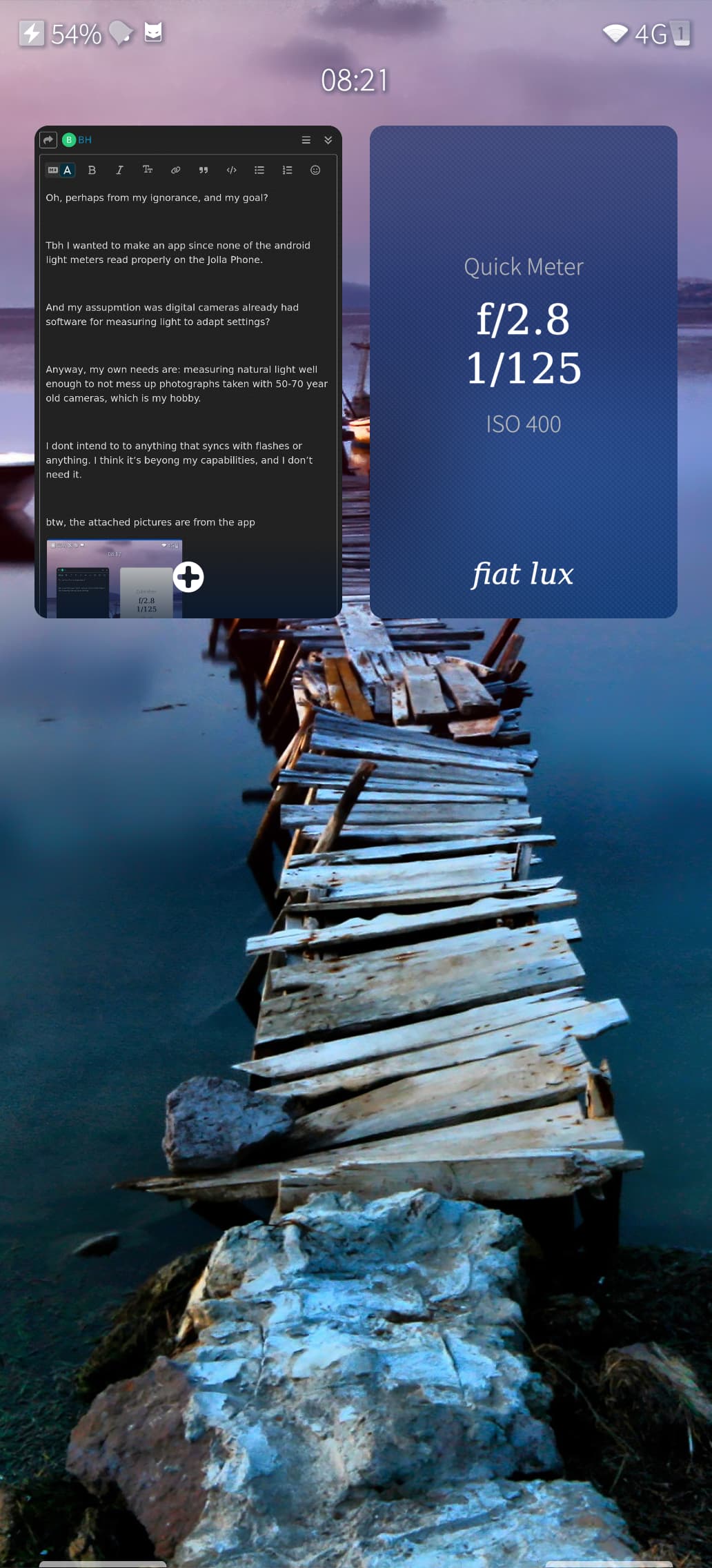
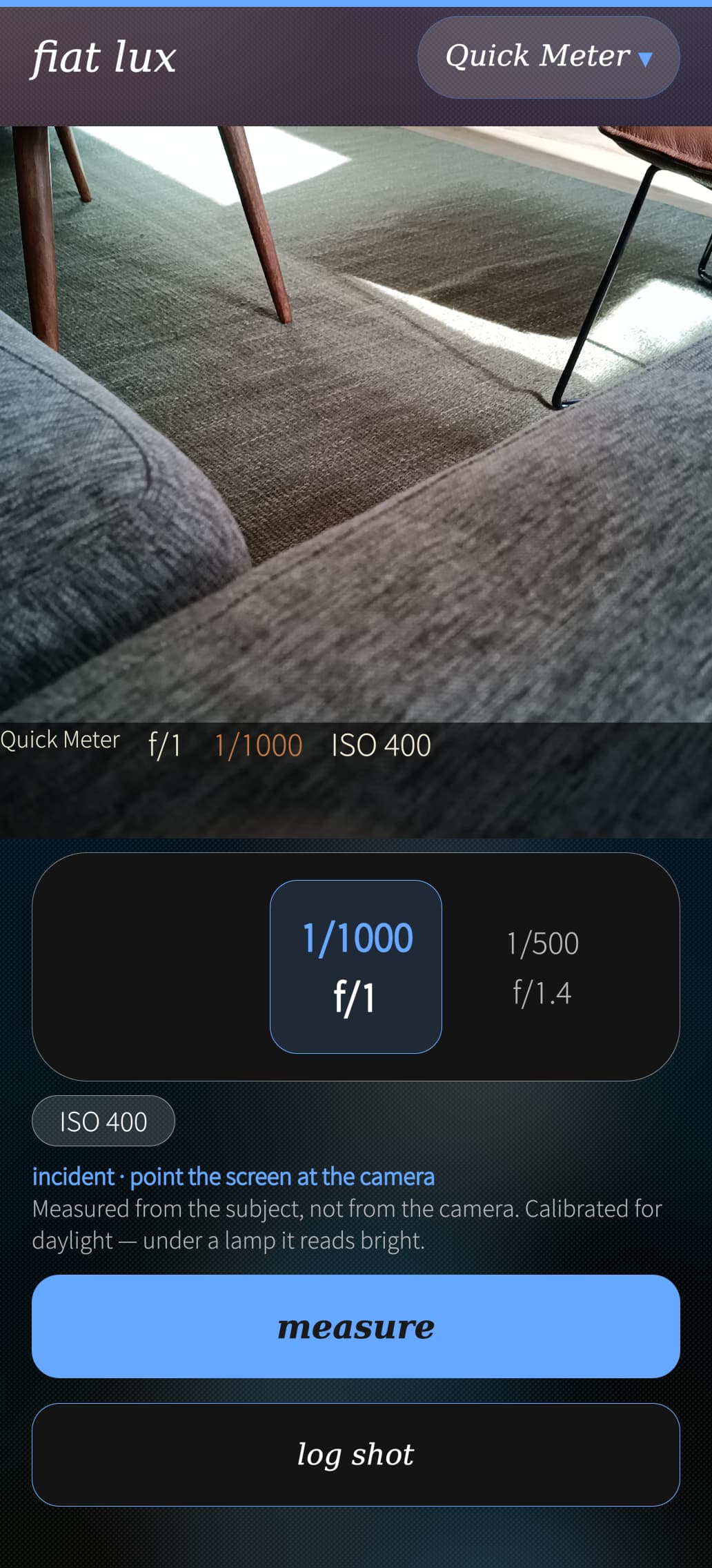
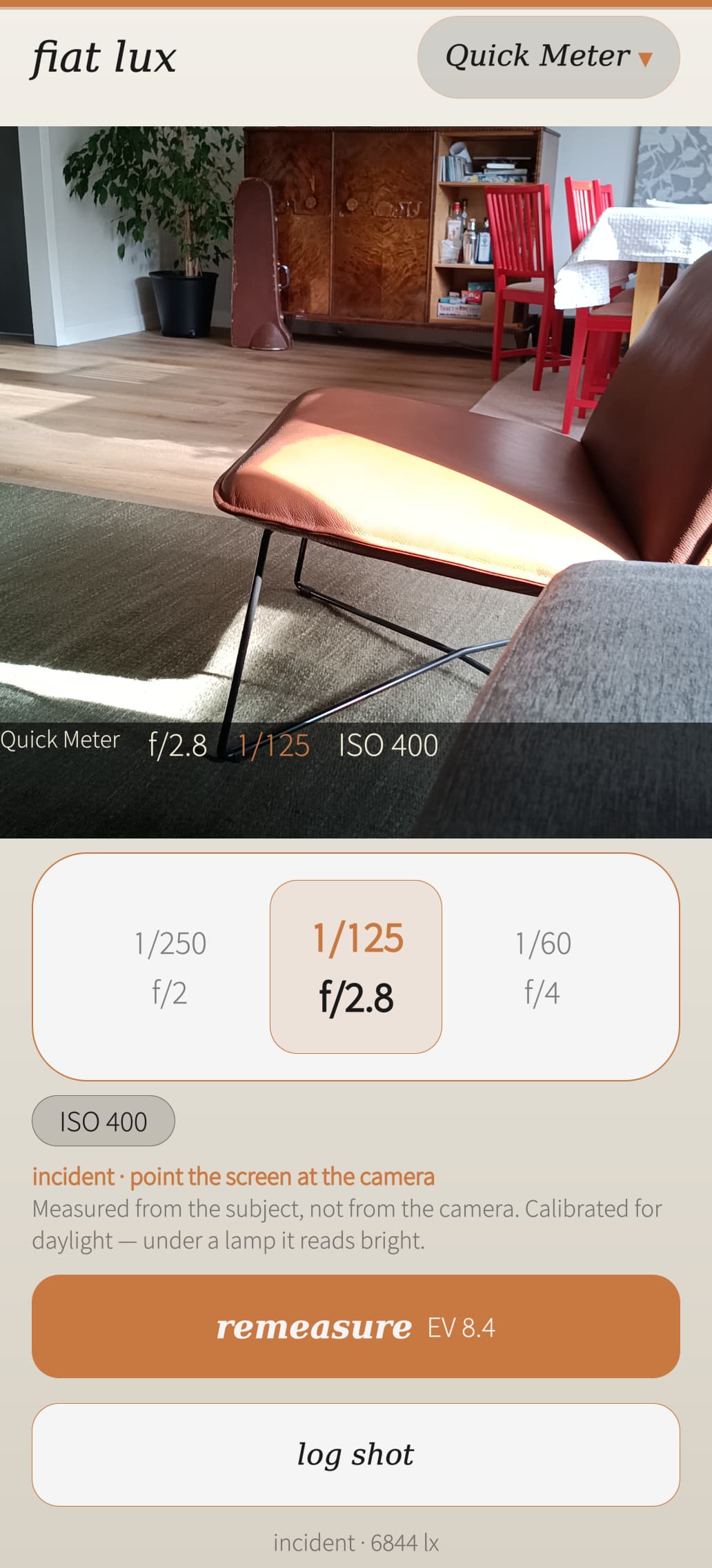
I’ve tried using the ambient photosensor for adjusting the light on the screen. But regardless of my attempts, I don’t get it to read properly. Without proper filter it reads light beyond what the human eye can see, thus gets it wrong. I haven’t been able to use either of the cameras to make correct readings either, and all android apps that work okay on android phones don’t read correct on the jolla phone…
Why do you advertise your idea for analogue photography only? At least for measuring incident light, you need a separate light meter also when using digital cameras.
Of course you could use it with every type of camera, analogue and digital alike. I was just wondering, why the word “Analogue” was deliberately written in the topic title, as it might result in much lower attention from the forum members.
Of course every digital camera comes with light and exposure measuring features out of the box and lets you define from which part of the frame you want to take the readings to adjust all exposure parameters. But this, naturally, only works for reflective light, that is the light which is reflected from the scene or subject towards the camera, through its lens and onto its sensor. Even a digital camera cannot measure incident light however, that is the light which shines from a particular light source onto the scene or subject (not the light which actually enters your camera lens). So for measuring incident light, you still need a separate exposure meter even in the digital age.
Well, its just a matter of replacing one single component. Instead of using the Vishay VEML7700 ambient light sensor that @munkstolen suggested, you could use one of the following:
That’s fine of course. I for myself would be interested in additional flash syncing however. It probably is much easier than one may think at first, at least for wired flash sync connections:
Equip the TOH with a proper flash sync port.
The 2 sensors from TI mentioned above have an interrupt pin which can be configured as an input to trigger a single measurement of defined duration.
Connect one of the outputs of this GPIO IC to a properly configured monostable multivibrator.
Connect the output of this multivibrator to both the interrupt pin of the light sensor and the flash sync port.
This way, you always get a reproducible correlation between flash triggering and light measurement, regardless of any timing differences on the I²C bus of the TOH.
Wow, this looks very nice - both the mode which follows the currently set ambience and the one which uses a fixed colour palette!
In fact, every app that deals with photo and video capturing or editing should always use neutral tones in its user interface (i.e. carefully selected grays) for proper judgement of colours. See here for more information: darktable user manual - color assessment
Yes, light/colormeters are also useful and needed to balance lightsources correctly, even if the capture dispositive is able of light/color measurement.
Just solder off the 2 black Qwiic connectors on the top side, configure it on the bottom side using solder bridges, screw it into your TOH shell and connect it to the TOH Base PCB described here:
Done. No flash syncing yet at this point, but maybe there are evaluation boards also for this purpose out there already, which can be combined with the above board.
Well, almost done. You still need to manufacture the TOH Base PCB yourself, but eventually Jolla will sell us such ready-made PCBs as accessories in the future. Who knows?
I “recently” got myself a handheld light meter, but would still be interested in this TOH, especially if it would give me a RGB/CMY readout.
How do you intend to design the TOH to make it useful for both incident and reflected light? The simplest would be to have the sensor sit on the opposite side of the display, but then you would have to turn around for incident light - and measuring e.g. on a copy board would not work.
I haven’t got a solid plan yet. Still going to experiment with reflective light before giving up.
But “planned” only incident.
But these things, RGB/CMY readouts, colour, flash sync, copy board. For a guy who only worked with film and natural light: what are those and how do you see them being on a TOH?
Measuring reflective light means: You point your light/colour sensor towards the subject you want to have in the frame.
Measuring incident light means: You point your light/colour sensor towards the light source whose properties you are interested in.
The measurement process itself and the sensor do not differ between these 2 methods.
Usually, in photography at least, you always take a single (gated) reading triggered by pressing a button, not a continuous reading. So it does not matter if you cannot see the display while measuring. You take the reading and turn the device display back towards you to see the result. That’s it.
RGB and CMY: 2 of many different ways to describe colour (or light in general) in the digital realm. Not relevant for analogue photography.
Colour: Does this really need to be explained? Highly relevant for both analogue and digital photography. Yes, even for black & white photography: Photographic filter - Wikipedia
Flash sync: (Not to be confused with the minimum flash sync time of a camera described here.) Relevant if you are using artificial light, flash light in particular, or a combination of natural and artificial light. When you want to measure the impact of your flash lights on the scene, your exposure meter needs to be able to trigger these flashes just as your camera would. To achieve this, you temporarily disconnect the flash sync cable from your camera and connect it to your exposure meter (or your TOH on your Jolla Phone) instead. Then you point your exposure meter at the region of interest and press a button. This will cause the exposure meter to trigger the flashes and make a measurement at the same time.
By the way: There is a board with the Vishay VEML7700 available too.
And the board with the TI OPT4048 is additionally available in a smaller (Mini) version. This Mini version is probably easier to integrate into a TOH, because the sensor IC is located on the bottom side of the PCB, not on the top side where all other components are.
Got it. Yeah, colour, well. Haha, I’ve just no filters for my analogue cameras. But got it, the use cases.
Would people be pissed if I use pc for flash synch?
like.
So, I just guess, it feels overwhelming atm.
Kind of just wanted accurate reading for my little use case. I get the wish to add more things. I just don’t know if I have the stamina to “over-develop” something that like 10 people might use.
I’ll give it a think
On the other hand. having everything in one TOH, as to not needing to change all the time, is also an argument.

 )
)

 Highly relevant for both analogue and digital photography. Yes, even for black & white photography: