Just to clarify: FelisBattery shows the reported full/design capacity from the kernel (CHARGE_FULL / CHARGE_FULL_DESIGN). This is not the same thing as the advertised nominal 5450 mAh capacity of the physical battery.
1 Like
And by the way, good catch - thanks for noticing.
Neither the Sailfish OS battery settings nor any of the battery monitoring apps I’ve tried so far show the full/draft battery capacity, so I didn’t notice this discrepancy either.
FelisBattery simply detects the values reported by the kernel and on the JP2026 they:
POWER_SUPPLY_CHARGE_FULL=3760000 POWER_SUPPLY_CHARGE_FULL_DESIGN=3760000
which means 3760 mAh.
You can verify this directly from the shell with:
cat /sys/class/power_supply/battery/uevent | grep -E ‘CHARGE_FULL=|CHARGE_FULL_DESIGN=’
The advertised battery capacity is 5450 mAh, so 3760 mAh vs. 5450 mAh is a significant difference. At the moment I don’t know whether this is a wrong battery profile, a driver/gauge reporting issue, or some internal reference value being exposed through the standard power-supply interface, but clearly something does not add up here.
So again, thanks for spotting it — I had not noticed this before either.
1 Like
I looked into this a bit further.
The 3760 mAh value shown by FelisBattery really comes directly from the kernel:
POWER_SUPPLY_CHARGE_FULL=3760000
POWER_SUPPLY_CHARGE_FULL_DESIGN=3760000
However, after checking the device tree and the MediaTek fuel-gauge runtime logs, it looks like this value does not actually correspond to the real full capacity of the battery.
The device tree contains 3760 as one of the MediaTek g-q-max values, while the actual fuel-gauge battery profiles and runtime calculations use values around 5.5–5.8 Ah, which is much more consistent with the advertised 5450 mAh battery.
So FelisBattery is displaying the kernel values correctly, but the CHARGE_FULL / CHARGE_FULL_DESIGN values exposed through sysfs on the JP2026 appear to be misleading or incorrectly mapped.
Interesting find — without your comment I probably would not have noticed this discrepancy either.
I will investigate this further for the next FelisBattery release.
I don’t want to simply replace the reported 3760 mAh with the advertised 5450 mAh, because FelisBattery is intended to show what the system actually reports.
Instead, I would like to determine exactly what the MediaTek driver is exposing through CHARGE_FULL / CHARGE_FULL_DESIGN and, if possible, show the actual fuel-gauge/profile capacity separately.
At the very least, the next version will make it clear that the current 3760 mAh value is the kernel-reported value and does not appear to represent the real full battery capacity.
If anyone has more insight into how MediaTek selects the battery profile or derives these CHARGE_FULL values, please let me know.
Cool app, so far it looks like when batery has more than 80% phone choose standard charging @ 5V, or there is some magical random, cant get direct charging mode even with same charger and cable what was fine at 70% of batt. will test more chargers and cables when i get discharged.
There is no Lithium powered device that charges at full power if battery is about 80%.
You can see technical explanation in my answer above.
3 Likes
Well i was thinking that direct charging will be the active mode but 5V will be neogated with less current above 80%
actual treshold is 85% here where direct mode @ 9V changed to standart mode @ 5V
TLDR: charging current will fall when battery is almost full.
Battery charging is often very complex.
Lithium batteries charge with constant current - CC until battery reaches it’s maximum voltage (usually somewhere about 4.4 V). Then the charging switches to constant voltage - CV. This is a simplification of course as there are other important factors like battery temperature or speed of voltage change for example.
Input voltage for charging controller is often dynamic and dependent on several factors. First is charger capability and second is charging power demand.
Smart chargers (which is almost all USB-C) tell their capabilities in the negotiations with charging controller.
The controller then usually ask for the highest possible power from the charger that the battery and charger can handle in each moment.
Note that the charger output voltage can be much higher then the battery one because it’s converted by the charging controller.
To further complicate that there are several types and versions of charger - controller communications.
And here somewhere lies the issue with Jolla Phone AFAIK. And that is the reason logs are needed.
1 Like
Yeah. I took away a battery from my Jolla Phone 2026 for 30 minutes to see what happens? Yes, it happened:
In addition to not able to charge, my Jolla loosed a battery calibration? (not showing anymore charge percentage in the screen and anywhere). That was on saturday.
Thus I can not load and install any coming updates anymore. The original spare batteries are at the moment sold-out in Jolla Store.
I managed to do the following: taking cds-picture. Charging with EP-TA-800 charger usb-A- usb-c.
It works for some moments. But my battery is damaged?? On friday evening it was shown the battery charge % on the screen as 1 %. 

1 Like
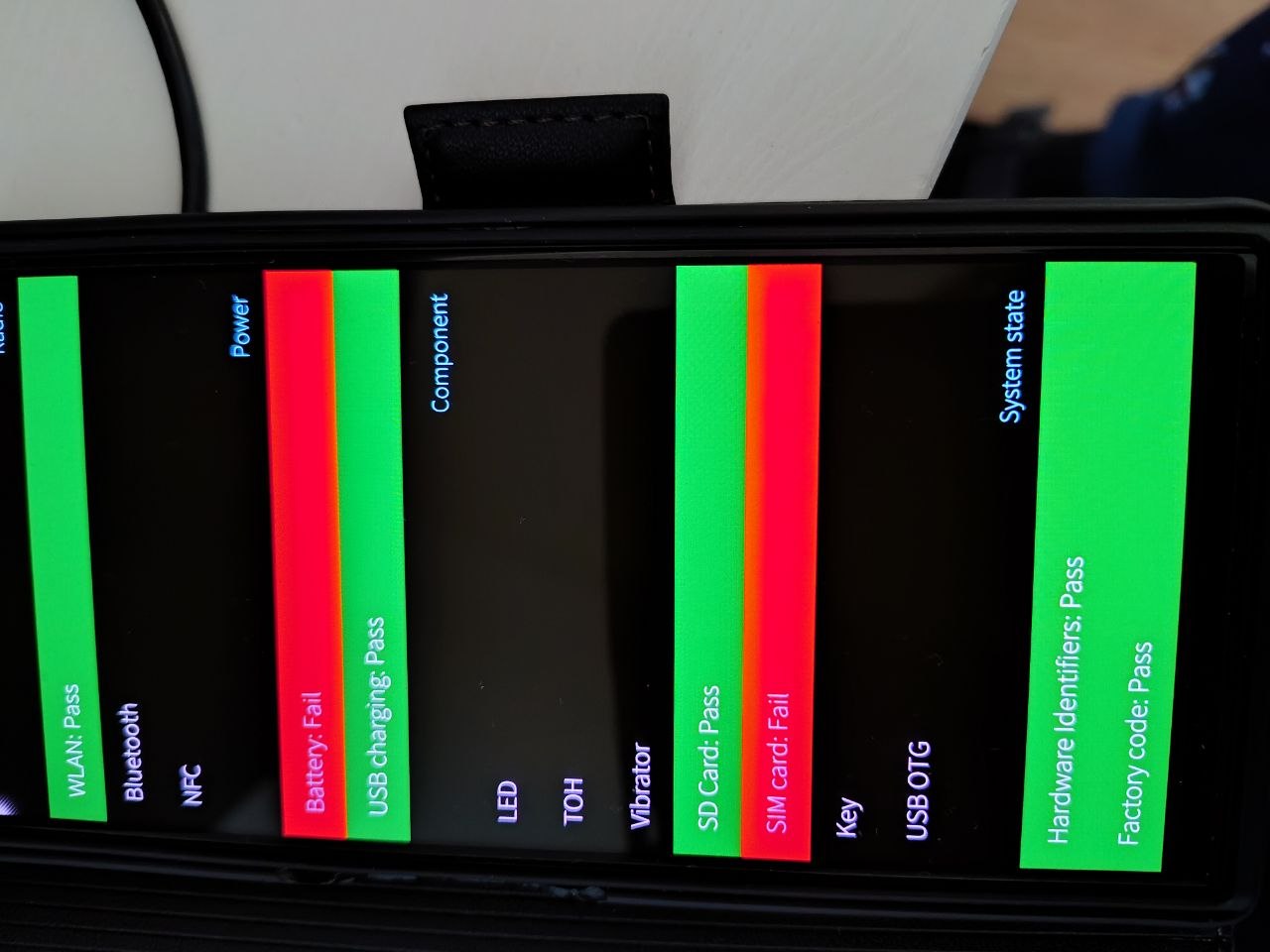
Ps. Only one sim-card. The second one is missing.
Addition: In the evening after several hours off:
Jolla Phone 2026 boots up every second time to show battery % as 70 - 74 %. (decreasing every time, respectively.)
Battery Buddy and Felis apps show equal charge - %.
Every second time it is booting without showing any charge value in the screen.
Battery Buddy and Felis show -1 V or 0 V. And 0 %.
Note:
Phone boots up only without a charger connected.
When charger is attached, the boot is stopping. But it continues when a charger is connected).
Also after start up to the home screen, when a charger is connected, Jolla starts booting again.
Good to know Jolla has power in battery, but something is badly wrong.
Addition:
Battery temperature shows -40 oC in Battery buddy and Felis apps. Also in cds. This is reason for error in cds.
1 Like
Small update regarding the battery capacity discrepancy
The kernel power_supply interface reports:
CHARGE_FULL=3760000
CHARGE_FULL_DESIGN=3760000
so applications correctly see 3760 mAh.
After checking the boot log, however, the MediaTek fuel-gauge subsystem appears to work with different capacity-related values. At boot it reports:
fg_check_bat_type: init battery type val:0 0
which indicates battery profile ID 0 is used and battery-type detection is disabled.
At nearly the same time, the fuel-gauge algorithm reports values such as:
Q:[55778 55778 55778 55778 57819]
which, using MediaTek’s 0.1 mAh internal units, correspond to approximately 5578–5782 mAh.
Jolla’s published nominal battery capacity is 5450 mAh.
So at the moment it looks like two parts of the battery stack are working with different capacity values: the standard Linux power_supply interface exposes 3760 mAh, while the runtime MediaTek fuel-gauge profile uses values around 5.6 Ah.
I have not yet found a clean read-only sysfs/proc interface exposing the runtime fuel-gauge Qmax, so I do not consider the exact cause confirmed yet.
4 Likes